A prospect asked me last month whether “NYSE CRM” was a different Salesforce product from the CRM they were already evaluating. It is not. NYSE: CRM is the ticker symbol for Salesforce, Inc. on the New York Stock Exchange. There is no separate NYSE edition, no special license, and no product called “NYSE CRM.”
The confusion is understandable. Search results mix stock pages with vendor pages, and a procurement team researching vendor stability can end up reading a quarterly earnings recap when it meant to compare editions. But the ticker is still worth understanding, because the company behind the software is a public company with public pressures, and those pressures eventually reach your renewal quote.
This is a reading guide, not investment advice. I am not recommending the stock. I am explaining what a buyer can reasonably take from the disclosures.
The ticker, decoded
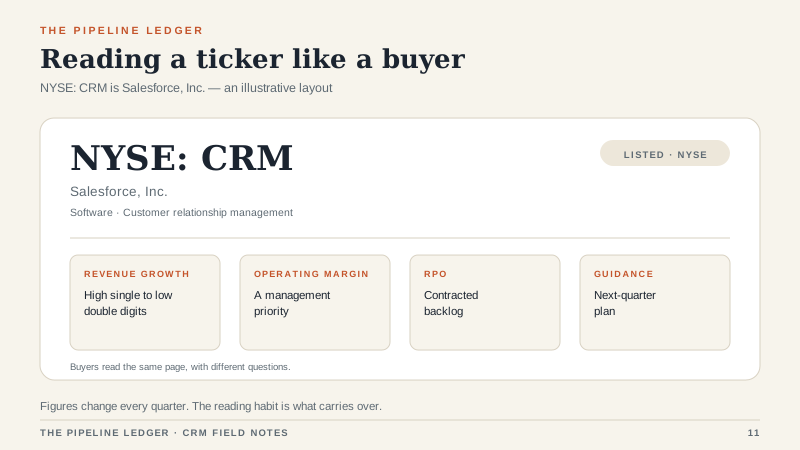
NYSE: CRM means the common stock of Salesforce, Inc. trades on the New York Stock Exchange under the symbol CRM. The “NYSE:” prefix tells you the exchange. “CRM” is the four-letter ticker, which happens to look like the product category. That coincidence is probably why the question comes up.
Salesforce is not the only public company in this market, but it is the largest pure-play CRM vendor, so its ticker gets treated as a proxy for the category. When people say “CRM is up” or “CRM is down,” they usually mean Salesforce stock, not the concept of customer relationship management.
What a buyer should notice
You do not need to build a financial model to get value from the disclosures. Four numbers tell most of the story.
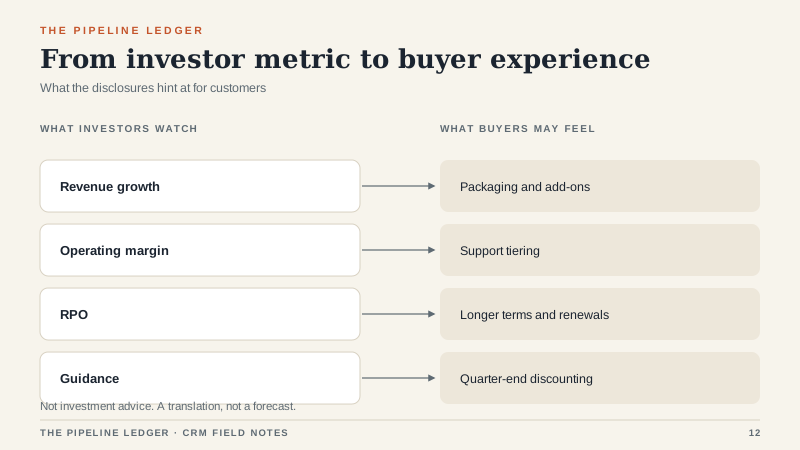
Revenue growth. Salesforce grew at a rapid clip for two decades. In recent years, growth has settled into the high single digits to low double digits. That is still growth, but it is a different company than the one that grew 30 percent a year. A maturing growth story usually means more attention to pricing, packaging, and margin.
Operating margin. Margin is the clearest signal of management’s priorities. When margin expansion becomes the headline, cost discipline follows. For customers, that can mean tighter support tiering, more packaging, and a harder line in negotiations.
Remaining performance obligation. RPO is the value of contracted revenue not yet recognized. It gives you a sense of how much future business is already booked. Growth in RPO can mean multi-year deals are getting longer or larger. It can also mean customers are locking in before a price increase.
Guidance. Management’s forecast tells you what the company expects next quarter and next year. It also tells you when the sales team will be under pressure to close. Quarter-end is when discounts appear. If you are negotiating, the fiscal calendar is your friend.
What the growth story means for customers
A public company has to grow. When the core CRM market matures, growth has to come from somewhere: new products, new geographies, price increases, or selling more to existing customers. Salesforce has been doing all four.
For buyers, that shows up in a few familiar places.
Packaging. Features that used to be included may move into add-ons or higher editions. AI capabilities, data tools, and advanced automation are the current frontier. Ask which capabilities are native to your edition, which require an add-on, and which consume credits.
Price increases. List prices go up, and renewal uplift clauses matter more than the initial discount. A three-year deal with a 7 percent annual escalator can cost more than a one-year deal at a higher headline price. Model the full term.
Support tiering. Margin pressure can show up as slower standard support, more self-service, and a stronger push toward premium support. If your team depends on phone support during US business hours, confirm what your edition actually includes.
Quarter-end behavior. A sales organization with a quarterly number is more flexible in the last two weeks of a quarter. That is not a secret. It is a calendar.
What the stock does not tell you
It does not tell you whether Salesforce is the right fit for your team. It does not tell you what implementation will cost, how long adoption will take, or whether your admin can run the org. A healthy vendor can still be a bad purchase if the scope is wrong.
It also does not tell you how much leverage you have. A large public vendor has more pricing flexibility than the first quote suggests, especially when a competitor is in the deal. The ticker tells you about the company. The negotiation tells you about your deal.
How to listen to an earnings call without becoming an analyst
You do not need to listen live. Read the shareholder letter or the prepared remarks and look for four themes.
Pricing and packaging language. Words like “monetization,” “consumption,” “credits,” and “premium SKUs” tell you where the company expects to make money. That is where your renewal will go.
AI product traction. Every enterprise vendor is selling AI. The useful question is whether customers are paying for it or getting it bundled. If it is bundled, expect the base price to carry the cost eventually.
Customer count and retention. Growth in large customer counts and a stable renewal rate suggest the platform is sticky. A shift toward fewer, larger customers can mean the company is prioritizing enterprise accounts over mid-market ones.
Guidance tone. Confident guidance often means less discounting. Cautious guidance often means the opposite. Neither is a reason to buy or wait on its own, but both are useful context when you are choosing a signing date.
The buyer’s takeaway
NYSE: CRM is just Salesforce’s ticker. The stock is a useful window into the vendor’s priorities, not a product recommendation. Use it to understand why prices move, why packaging changes, and why the sales team behaves differently in the last week of a quarter. Then go back to the only question that matters: can this system support the way your team sells, at a total cost you can defend?
Vendor health matters. Fit matters more. A public company with a great quarter will still sell you the wrong edition if you let it. If you are already running the platform, the cleanup plan for an inherited SFDC org covers the operational side.
